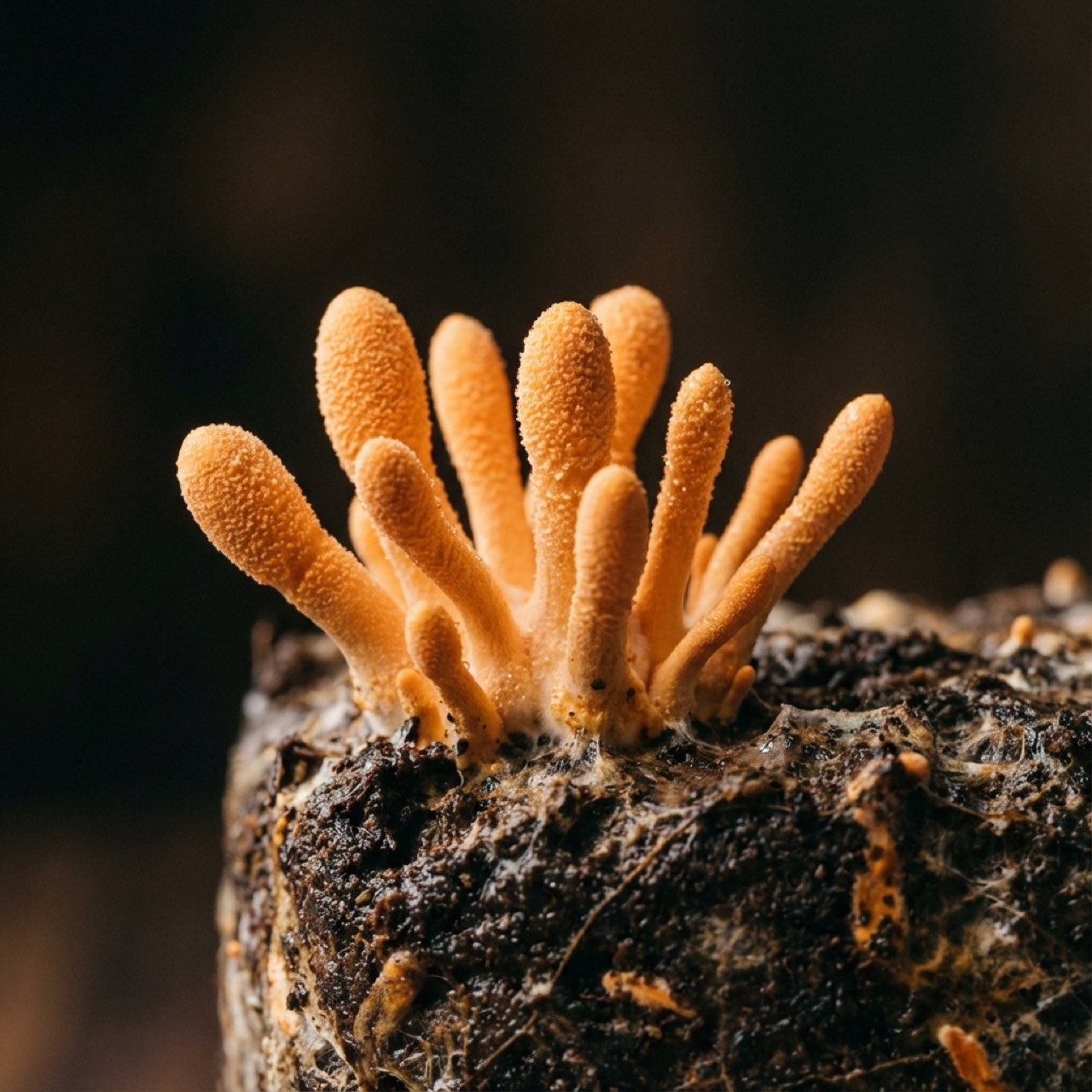
Direct Answer
Does Cordyceps boost testosterone? The honest answer: preclinical evidence (rodent models) suggests Cordyceps may support Leydig cell function — the cells that synthesise testosterone — via adenosine-cAMP signalling and AMPK activation. There is no large-scale human RCT confirming direct testosterone increases. However, Cordyceps demonstrably improves exercise performance (+11.8% VO₂max, Hirsch 2017), reduces fatigue, and may buffer cortisol — all of which indirectly support healthy testosterone levels in active men. It is a legitimate vitality tool, not a pharmaceutical testosterone booster.
Key Takeaways
- Preclinical (animal) evidence suggests Cordyceps may support testosterone synthesis via Leydig cell cAMP pathways — but this has not been confirmed in large human trials.
- Indirectly supports testosterone through improved exercise capacity, reduced fatigue, and potential cortisol buffering — all of which are established testosterone regulators.
- AMPK activation by cordycepin (Song et al. 2015) improves mitochondrial function in steroidogenic cells — theoretically supporting hormone synthesis.
- Traditional TCM use for male vitality and "kidney yang" is well-documented; modern mechanisms provide partial scientific support.
- Dosage: 1.5–3g standardised extract daily; effects on vitality typically apparent at 4–8 weeks of consistent use.
Traditional Use: Cordyceps as a Male Vitality Tonic
Cordyceps has a 1,000-year history in Traditional Chinese Medicine as a tonic for male vitality, kidney yang, and reproductive function. Classical texts including the Pen Ts'ao Pei Yao (Supplement to the Materia Medica) list Cordyceps as a treatment for fatigue, impotence, and loss of vigour — what modern medicine would recognise as symptoms of low testosterone or adrenal fatigue.
In TCM, "kidney yang" is the energy that governs reproductive function, physical strength, and sexual vitality. The kidneys in this framework do not map precisely to the anatomical organs — they represent the energetic foundation that testosterone supports in modern physiology. When early physicians described Cordyceps as a "kidney yang" tonic, they were describing the same cluster of male vitality benefits we now associate with healthy testosterone function.
This traditional use predates clinical research by centuries. The question is: do modern mechanisms provide biological plausibility for these observed effects?
What "Testosterone Support" Actually Means
Before examining the evidence, it is important to clarify what "supporting testosterone" means in practice. There are two very different claims often conflated in supplement marketing:
- Pharmacological testosterone increase: A drug or compound that directly raises serum testosterone, often by mimicking LH (luteinising hormone) or blocking negative feedback. This is the mechanism of anabolic steroids and SARMs. Cordyceps is not in this category.
- Physiological support of healthy testosterone function: Removing obstacles to normal testosterone production (stress, poor mitochondrial function, chronic fatigue) or supporting the cellular machinery of steroidogenesis. This is where Cordyceps has plausible evidence.
The distinction matters. Men expecting Cordyceps to produce anabolic steroid-level hormone changes will be disappointed. Men looking to support their body's natural testosterone production capacity — especially if chronic stress, fatigue, or suboptimal training are limiting factors — will find the evidence more relevant.
The Cortisol-Testosterone Relationship
The most clinically coherent pathway by which Cordyceps may support male hormone health is through the HPA axis (hypothalamic-pituitary-adrenal axis). Here is the mechanism:
- Chronic stress elevates cortisol: Sustained high cortisol — from overtraining, work pressure, sleep debt, or poor recovery — signals the hypothalamus to reduce GnRH (gonadotropin-releasing hormone) output.
- GnRH suppression reduces LH: Less GnRH means less LH from the pituitary.
- LH drives testosterone synthesis: Leydig cells in the testes depend on LH signalling to produce testosterone. Less LH = less testosterone.
- Adaptogenic compounds interrupt this cycle: By reducing the physiological cost of chronic stress — via anti-inflammatory mechanisms and mitochondrial support — adaptogens can reduce the cortisol load that suppresses this cascade.
Cordyceps is classified as an adaptogen. Its anti-inflammatory mechanisms (NF-κB and COX-2 inhibition, confirmed in multiple preclinical studies) and its role in ATP synthesis address the energetic and inflammatory burden of chronic stress. Whether these translate into measurable cortisol reduction in humans is not conclusively established — unlike ashwagandha, which has RCT evidence for cortisol reduction. Cordyceps' adaptogenic evidence is mechanistic and traditional rather than directly demonstrated in hormone panels.
The Leydig Cell Evidence
The most direct evidence comes from preclinical studies. Leydig cells — the testosterone-producing cells in the testes — express adenosine receptors. Cordycepin (3'-deoxyadenosine, the primary bioactive in Cordyceps militaris) is an adenosine analogue that can interact with these receptors and modulate cAMP signalling.
The cAMP pathway is the same intracellular signalling cascade that LH uses to trigger testosterone synthesis. In rodent models, Cordyceps extracts have been associated with increased testosterone output from Leydig cells under conditions of stress or fatigue. These are animal studies — they establish biological plausibility rather than clinical efficacy in men. Extrapolating directly from rodent testosterone data to human hormone panels is not scientifically valid, and any supplement marketing that does so is overstating the evidence.
What this means for you: there is a real mechanistic basis for Cordyceps' traditional use as a male vitality tonic. The evidence does not yet support the kind of specific quantified claims ("increases testosterone by X%") that would require human RCT confirmation.
AMPK Activation and Steroidogenic Function
Song et al. (2015) confirmed that cordycepin activates AMPK — the cellular energy sensor — in muscle cells, reducing lactate and improving mitochondrial efficiency. This finding has implications beyond muscles: steroidogenesis (hormone synthesis) is a mitochondrial-dependent process. Testosterone production in Leydig cells requires healthy mitochondria to convert cholesterol into pregnenolone, the precursor to all steroid hormones.
If AMPK activation improves mitochondrial function broadly (not just in muscles), this could support the steroidogenic capacity of Leydig cells. This is a plausible but unproven extrapolation from the Song 2015 findings. It adds a second mechanistic pathway to the theoretical support for Cordyceps in male hormone health, without constituting clinical evidence. Notably, AMPK is also the primary pathway through which Cordyceps may support blood glucose regulation — directly relevant for Indian men with metabolic syndrome or insulin resistance, where chronically elevated blood sugar suppresses Leydig cell function and reduces testosterone output.
Exercise Performance: The Indirect Testosterone Path
This is the most evidence-supported indirect pathway. The relationship between exercise and testosterone is well-established:
- Resistance training and high-intensity exercise acutely increase testosterone.
- Consistent training over time improves baseline testosterone in men who were previously sedentary or overtrained into suppression.
- Greater training capacity → better training stimulus → more consistent testosterone support.
Cordyceps improves exercise capacity. The Hirsch et al. 2017 double-blind RCT (n=28, 4g/day, 3 weeks) documented +11.8% VO₂max improvement versus +0.9% placebo. Improved VO₂max enables harder, longer training sessions — which drive the testosterone response through normal exercise physiology.
This is not a subtle effect. Cordyceps enables more effective training, which drives more robust testosterone signalling, through a completely established chain of physiology. For Indian men who are active but limited by fatigue or suboptimal endurance, this is the most pragmatic argument for Cordyceps.
For sport-specific dosing protocols, see our guides on Cordyceps for endurance athletes and Cordyceps for high-intensity training.
India-Specific Context: Why This Matters for Indian Men
Several factors make this topic particularly relevant in India:
| Factor | Indian Context | Testosterone Relevance |
|---|---|---|
| Urban stress burden | India ranks high in workplace stress indices; long hours, commute burden common | Chronic cortisol elevation suppresses LH and testosterone via HPA axis |
| Vegetarian / low-meat diets | ~40% vegetarian; lower average saturated fat intake (testosterone synthesis requires dietary fat) | Cordyceps is 100% vegan; supports mitochondrial efficiency regardless of diet composition |
| Overtraining in fitness-conscious men | Growing gym culture; overtraining syndrome increasingly common in amateur athletes | Cordyceps reduces recovery time and lactate, enabling training volume that supports testosterone without crossing into overtraining suppression |
| Supplement market quality | India's vitality supplement market is flooded with ashwagandha + shilajit blends of variable quality | Cordyceps militaris (FSSAI-certified, HPLC-tested) offers a complementary mechanism with a distinct evidence profile |
| Cost vs wild keeda jadi | Wild Cordyceps sinensis costs ₹10–15 Lakh/kg — completely inaccessible | Lab-grown Cordyceps militaris at ₹25–100/g provides superior cordycepin content at 99% lower cost |
Cordyceps vs Ashwagandha for Male Vitality
Indian men considering natural testosterone support often compare Cordyceps and Ashwagandha. These are complementary, not competing:
- Ashwagandha (KSM-66) has RCT evidence for cortisol reduction and statistically significant testosterone increases in men under chronic stress (Wankhede et al. 2015). It works primarily through HPA axis modulation.
- Cordyceps militaris works through ATP production, mitochondrial support, and exercise capacity improvement — targeting the energetic foundation of hormonal function rather than the endocrine axis directly.
- Combining both addresses the hormonal (ashwagandha) and metabolic (Cordyceps) dimensions simultaneously. Many clinical formulators now include both in male vitality stacks, each at effective doses (300–600mg ashwagandha KSM-66, 1.5–3g Cordyceps militaris extract).
For more context on how Cordyceps compares to other energy-supporting compounds, see our Cordyceps vs caffeine comparison and the complete Cordyceps benefits guide.
Dosage for Men Targeting Vitality
- Starting dose: 1g standardised extract daily (first week, to assess tolerance)
- Maintenance dose: 1.5–2g daily with breakfast
- Performance + vitality stack dose: 2–3g daily, split between morning and pre-workout (30–60 minutes before exercise)
- Minimum effective duration: 4–8 weeks for vitality and energy benefits; endurance improvements measurable from week 3
- Product: Synervion SYNV-CORE capsules — 500mg per capsule, standardised militaris extract, batch-specific CoA available
For a full timing guide based on your primary goal, see when to take Cordyceps.
Safety for Men
Cordyceps militaris at 1–3g standardised extract daily is well-tolerated in men. Specific considerations:
- No documented androgenic side effects: Cordyceps does not appear to have direct androgenic activity (unlike prohormones or DHEA). It will not produce acne, hair loss, or voice changes.
- Blood pressure: Contains adenosine, which has mild vasodilatory effects. Men on antihypertensive medications should monitor blood pressure — additive hypotensive effect is theoretically possible.
- Anticoagulants: Cordyceps may have mild platelet-inhibiting properties. If you take warfarin, heparin, or aspirin regularly, consult your physician.
- Prostate health: No evidence of adverse effects on prostate function at standard doses. Men with prostate conditions should disclose supplementation to their urologist.
- Immunosuppressants: Cordyceps modulates immune function. If you are on immunosuppressant medication, consult your physician before use.
Full safety review: Cordyceps side effects & drug interactions.
The Bottom Line
Cordyceps militaris is not a pharmaceutical testosterone booster, and any product claiming otherwise is overstating the evidence. What it is: a well-researched metabolic support compound with traditional credibility for male vitality and modern mechanistic plausibility via Leydig cell cAMP pathways, AMPK activation, and exercise performance enhancement. For Indian men dealing with chronic stress, training fatigue, or simply looking to support their vitality through evidence-based supplementation, Cordyceps militaris is a credible tool — especially when combined with consistent resistance training and adequate sleep, which are the most reliable natural testosterone supports available.