Direct Answer
Lab-grown Cordyceps militaris sells for approximately ₹15,000 to ₹75,000 per kg in India depending on grade, form, and batch size. Wild keeda jadi costs ₹10 to 15 Lakh per kg. For bulk buyers (5 kg+), request a formal quote from the manufacturer because rack rates are rarely what gets paid at scale.
Why the Price Range Is So Wide
Buyers who search "Cordyceps militaris price per kg" and find three quotes ranging from ₹15,000 to ₹75,000 on the same day are not looking at the same product. Four variables drive most of the spread:
- Form: Dried fruiting body, powder, 10:1 extract, and liquid extract are not interchangeable. Extract concentrate costs more per gram because it takes 10 kg of material to produce 1 kg of product.
- Cordycepin content: Suppliers who test to HPLC and can show 0.5%+ cordycepin will charge more than those who cannot. The spread between 0.1% and 1.0% cordycepin is meaningful at clinical dosages.
- Batch size: A 1 kg trial order and a 50 kg recurring order are priced differently. This is true everywhere in ingredient supply; Cordyceps is not an exception.
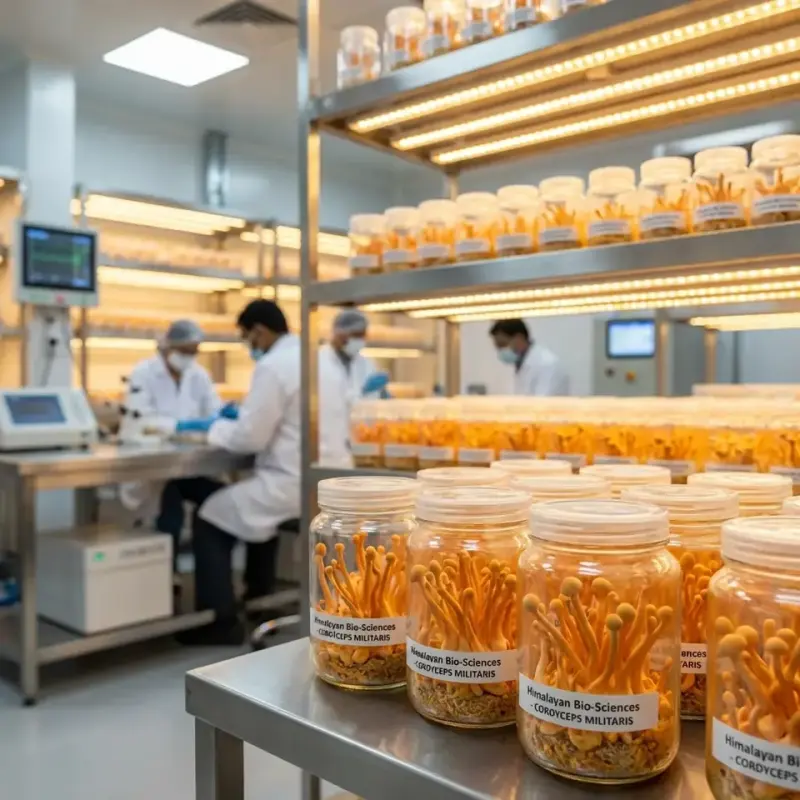
- Cultivation method: Lab-grown on controlled substrate with documented growing conditions costs less than wild-harvested Himalayan keeda jadi, but more than mycelium-on-grain products that are sold as "Cordyceps" but deliver almost no active compounds.
Sound familiar? If you have been quoted ₹8,000 per kg from a supplier on IndiaMART and ₹40,000 per kg from a manufacturer with HPLC reports, you are probably comparing apples to a laboratory.
Wild vs Lab-Grown: A 100:1 Price Difference, Not 50:1
Wild keeda jadi (Ophiocordyceps sinensis) prices in India run ₹10 to 15 Lakh per kilogram for authenticated Himalayan specimens. Lab-grown Cordyceps militaris retails at roughly ₹25 per gram (₹25,000/kg) and wholesales significantly below that for bulk orders.
The cordycepin content comparison changes the math entirely. A head-to-head comparison of militaris vs sinensis shows that quality-controlled lab-grown militaris delivers 4 to 8 times more cordycepin than wild sinensis, at roughly 1% of the cost. For a nutraceutical formulator sourcing active compounds rather than a prestigious label, this is not a difficult calculation.
Our view: buyers who insist on wild keeda jadi for formulation are paying a provenance premium, not a potency premium. Unless the finished product story specifically requires Himalayan origin, lab-grown militaris from a verified manufacturer delivers better value and better batch-to-batch consistency.
Price by Product Form
Here is a rough orientation for bulk buyers in India as of 2026. These are market ranges, not Synervion's specific rates. Request a formal quote for your actual volume and specification:
| Form | Typical Market Range (per kg) | Key Spec to Check |
|---|---|---|
| Dried fruiting body (whole) | ₹15,000 to ₹40,000 | Colour, moisture content, absence of mycelium filler |
| Fruiting body powder (standardised) | ₹20,000 to ₹50,000 | HPLC cordycepin %, microbial limits, mesh size |
| 10:1 dual extract | ₹60,000 to ₹1,50,000 | Cordycepin + adenosine by HPLC, beta-glucan content |
| Mycelium-on-grain (biomass) | ₹2,000 to ₹8,000 | Avoid for functional formulations: mostly starch, minimal actives |
A buyer who received a quote in the ₹2,000 to ₹8,000 range and assumed it was competitive pricing for Cordyceps is almost certainly looking at mycelium biomass. This is not a trivial distinction: a product that contains mostly grain starch and labels itself "Cordyceps" is a regulatory and reputational liability for any brand that puts it in a supplement.
Quality Grading: What Moves the Price Up
Three quality signals justify a premium price from a reputable supplier:
- HPLC-verified cordycepin content with a batch-specific COA. Any supplier who cannot produce this is selling on trust, not evidence.
- Heavy metal and pesticide testing against FSSAI or USP limits. Cordyceps grown on contaminated substrate will carry those contaminants into the finished product.
- Documented cultivation strain and passage number. A manufacturer who maintains a proprietary strain bank and can tell you which generation the batch came from is operating at a different level of consistency than one who restarts from purchased spawn each cycle.
A Bengaluru contract manufacturer we spoke with put it plainly: "We stopped buying on price after one batch where the COA looked fine but the finished capsules had zero effect. HPLC of our input confirmed 0.02% cordycepin. We were sold starch." That is not a supplier selection story. That is a product recall story that got avoided by good QC. Start with the COA.
How Batch Size Affects Wholesale Pricing
For any bulk ingredient, the unit price compresses as volume rises. Cordyceps militaris follows the same curve. A 1 kg trial quantity is priced to cover the cost of testing, sampling, and the manufacturer's time in onboarding a new buyer. A 20 kg per month recurring order is priced differently because the relationship has value.
A practical approach: request a trial sample (most reputable manufacturers offer 50-100g sample quantities for qualified buyers), run your own HPLC, and then negotiate terms on a recurring basis. The manufacturers worth working with expect this process. The ones who resist COA scrutiny are telling you something.
For wholesale Cordyceps militaris inquiry, contact Synervion directly. We do not publish rack rates because the right price depends on specification, volume, and delivery schedule. What we can say: we do not sell mycelium biomass, we test every batch to HPLC before it leaves the facility, and our COAs are batch-specific, not generic.
Red Flags in Low-Price Cordyceps Quotes
Five things that should trigger a closer look when a price seems too good:
- No batch-specific COA. A generic COA from 2024 covering a 2026 batch is not a COA.
- No HPLC method specified. "Third-party tested" without naming the lab and method is a claim, not evidence.
- Price below ₹10,000 per kg for "fruiting body powder." At that price, the material is almost certainly mycelium biomass or adulterated.
- No ability to visit the facility or audit production records. A legitimate cultivator welcomes qualified buyer audits.
- Vague origin claims. "Himalayan Cordyceps militaris" from a supplier who cannot name the elevation or collection region is unlikely to be authentic.
How to Source Cordyceps Militaris in Bulk from India
The most direct path for nutraceutical brands, contract manufacturers, and private-label companies:
- Define your specification first: form (powder vs extract), cordycepin target (%), microbial limits, mesh size, packaging requirements.
- Request samples from two or three manufacturers. Test independently before committing volume.
- Ask for a facility audit or at minimum a video walkthrough of the cultivation area. A genuine biotech cultivator will not hesitate.
- Negotiate on volume, not just unit price. Payment terms, lead time, and minimum order quantity matter as much as per-kg rate.
Synervion's facility is in Barwani, Madhya Pradesh. We grow on sterile fruiting-body substrate, not on grain. Every batch is tested before dispatch. If you are building a product that depends on Cordyceps actually doing something, that distinction matters. Contact us for a wholesale inquiry or read more about our bulk supply programme.