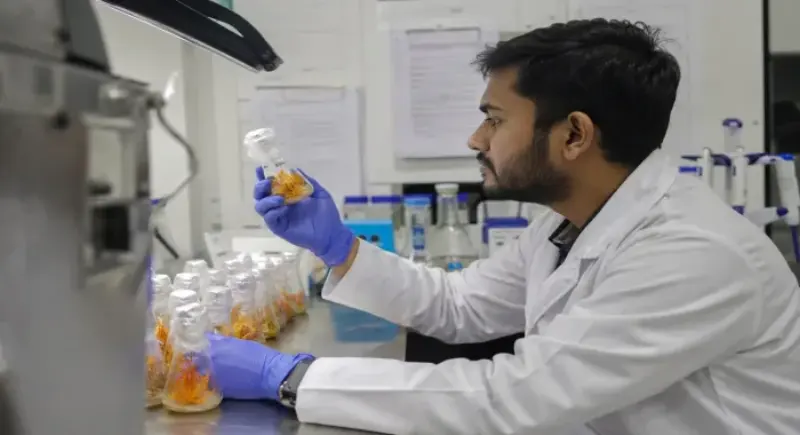
Executive Summary: For centuries, Traditional Chinese Medicine (TCM) revered Cordyceps as a panacea. Today, modern chromatography and clinical trials allow us to verify those claims. This report summarizes the key evidence for B2B buyers and health professionals. For a broader overview of all studied benefits see our complete Cordyceps militaris benefits guide.
The "Master Molecule": Cordycepin
The primary bioactive compound in Cordyceps militaris is Cordycepin (3'-deoxyadenosine). It is a nucleoside analogue, meaning it is structurally almost identical to Adenosine, the backbone of ATP (cellular energy).
This structural mimicry allows Cordycepin to participate in various biochemical pathways, including:
- RNA Synthesis Inhibition: Slowing the rapid division of rogue cells.
- Anti-Inflammatory Signaling: Modulating the NF-κB pathway to reduce systemic inflammation.
- Metabolic Regulation: Activating AMPK to improve insulin sensitivity and energy use.
Clinical Domain 1: Energy & Endurance
This is the most well-documented benefit. A meta-analysis of studies involving endurance athletes shows consistent improvements in Time to Exhaustion (TTE).
The mechanism is twofold: improved blood flow (vasodilation via Nitric Oxide) and increased ATP turnover. Unlike stimulants which chemically force the adrenal glands to fire, Cordyceps provides the *fuel* for the engine.
Read the full Athlete's Report →Clinical Domain 2: Immune Modulation
Research published in International Immunopharmacology highlights the bidirectional effect of Cordyceps polysaccharides. The immunology, including NK cell activation data, is explained in depth in our Cordyceps immune system support guide.
- Under-active Immunity: Promotes macrophage activity to fight infection.
- Over-active Immunity: Can help down-regulate autoimmune responses (though more human trials are needed here).
This "adaptogenic" quality makes it a staple for post-illness recovery.
Wild vs. Cultivated: The "Potency Paradox"
For decades, the market believed that wild *Cordyceps sinensis* (costing $20,000/kg) was superior. However, recent comparative studies using HPLC (High-Performance Liquid Chromatography) tell a different story. The full side-by-side analysis is in our Cordyceps militaris vs sinensis comparison.
Cultivated *Cordyceps militaris* consistently yields higher levels of Cordycepin and Adenosine than its wild counterpart.
The Synervion Standard
By controlling the substrate, light, and oxygen levels in a lab environment, we can "pre-program" the synthesis of specific compounds. Wild harvesting is a gamble; Lab-Grown is a science.
The Studies Behind These Conclusions
Each entry below opens a full breakdown of the paper: what was measured, the reported effect size, and the DOI. We keep these as standalone pages so formulators can check a claim against its source rather than take our summary on trust.
Performance and Fatigue
- Cordyceps militaris Improves Exercise Tolerance in Humans, J. Dietary Supplements, 2017 (Endurance Performance)
- Anti-fatigue Property of Cereal Grains Mixed with C. militaris, J. Int. Soc. Sports Nutrition, 2016 (Sports Nutrition)
- Studies on the Antifatigue Activities of C. militaris Extract, Evid-Based Compl. Alt. Med., 2015 (Antioxidant Defense)
Cellular Energy Mechanism
- Cordyceps militaris: Mechanisms for Cellular Energy Enhancement, Mycobiology, 2020 (Energy Metabolism)
Cultivated vs Wild
- Cordyceps militaris: A Superior, Cultivated Alternative, Mycol. Progress, 2012 (Comparative Analysis)
Cultivation, Yield and Quality Control
These are the papers that underpin how we run the facility, and why a lab-grown batch can be specified rather than hoped for.
- IoT-Driven Fermentation System for Enhanced Cordycepin Production, Int. J. Med. Mushrooms, 2025 (Biotech Innovation)
- Development of High Cordycepin-Producing Cordyceps militaris Strains, Mycobiology, 2017 (Strain Engineering)
- Enhancement of Cordycepin Production by Epigenetic Modification, Biotechnol. Lett., 2022 (Advanced Cultivation)
- Characterization of Newly Bred Cordyceps militaris Strains, J. Microbiol. Biotechnol., 2017 (Quality Control)
- High-Level Production of Cordycepin by Xylose-Utilizing Strain, Bioresource Tech., 2023 (Sustainable Production)
Conclusion
The transition from "Folk Medicine" to "Functional Food" is complete. The data supports Cordyceps militaris as a safe, effective, and scalable solution for modern metabolic and energy challenges. Brands and formulators sourcing certified-assay material can review batch specifications on our wholesale Cordyceps supply page.